


 805.934.4600

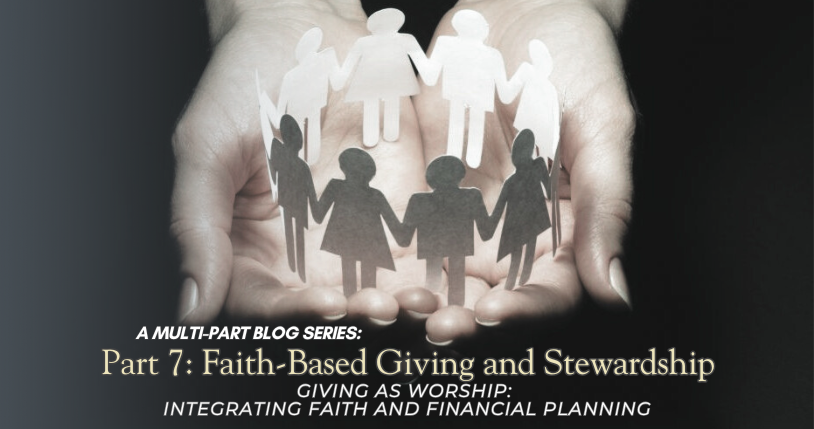
Part 7: Faith-Based Giving and Stewardship
Giving as Worship: Integrating Faith and Financial Planning
For many donors, charitable giving is not merely a financial decision, it is a spiritual obligation. It reflects a worldview shaped by faith, stewardship, and a sense of divine calling. In this seventh installment of our series, we explore how religious convictions influence charitable planning, and how giving can become an act of worship, not just a line item in a budget.
Faith-based giving is deeply rooted in history. From the ancient practice of tithing to modern philanthropic movements inspired by religious teachings, believers have long understood generosity as a moral and spiritual imperative. But in today’s complex financial landscape, integrating faith with planning requires intentionality, strategy, and clarity of purpose.
The Spiritual Foundation of Giving
In many religious traditions, giving is seen as a response to grace; a way to acknowledge that all we have is entrusted to us, not earned by us. The concept of stewardship teaches that wealth is not an end in itself, but a tool to be used for the good of others and the glory of God.
For Christians, this principle is often expressed through tithing (giving 10% of income) and almsgiving (supporting the poor and vulnerable). In Judaism, tzedakah is a central tenet, emphasizing justice and responsibility. In Islam, zakat is one of the Five Pillars, requiring believers to give a portion of their wealth to those in need.
These practices are not merely obligations, they are acts of worship. They reflect a heart posture of gratitude, humility, and trust. And they remind us that giving is not about loss, but about participation in something greater than ourselves.
Aligning Financial Planning with Faith
Faith-based giving should not be disconnected from financial planning. In fact, the most impactful giving often results from thoughtful integration of spiritual values with legal and tax strategies. When donors align their charitable goals with their estate plans, investment portfolios, and business interests, they create a holistic approach to stewardship.
This begins with clarity. What causes reflect your faith commitments? What organizations align with your values? How do you want your giving to reflect your beliefs; not just in what you support, but in how you give?
For example, some donors prioritize giving to their local church or religious institution. Others support faith-based schools, missions, or humanitarian efforts. Still others focus on justice, reconciliation, or community development, all expressions of faith in action.
Once these priorities are clear, planning can begin. Tools such as donor-advised funds, charitable trusts, and private foundations can be structured to reflect religious values. For instance, a donor-advised fund can be housed within a faith-based sponsor, allowing grants to be directed toward ministries and organizations that share the donor’s convictions.
Charitable remainder trusts can provide income to the donor while supporting a religious institution at death. Private foundations can be governed by faith-informed principles, with mission statements that reflect theological commitments. Even business succession plans can include charitable components that honor the donor’s spiritual legacy.
Teaching Stewardship Across Generations
One of the most powerful aspects of faith-based giving is its ability to shape family culture. When parents model generosity as an expression of faith, children learn that giving is not simply a financial habit, but rather, it’s a spiritual discipline.
Foundations and donor-advised funds offer opportunities for families to make charitable decisions together. Board meetings can include prayer, reflection, and discussion of values. Grantmaking can become a way to teach discernment, compassion, and responsibility.
I’ve worked with families who use their charitable planning as a discipleship tool. They invite their children to research organizations, propose grants, and reflect on how their giving aligns with their beliefs. Over time, these practices build a legacy of faith and generosity that transcends financial wealth.
Navigating Challenges and Opportunities
Faith-based giving also presents unique challenges. Donors must ensure that their gifts comply with IRS rules, especially when supporting religious institutions or international ministries. They must also navigate the tension between personal convictions and public accountability, particularly when operating a foundation or making high-profile gifts.
But these challenges are also opportunities. They invite donors to be thoughtful, transparent, and strategic. They encourage collaboration with advisors who understand both the technical and spiritual dimensions of giving; and they create space for innovation and new models of philanthropy that reflect timeless truths.
For example, some donors establish mission-aligned investment portfolios, ensuring that their charitable assets are invested in ways that reflect their values. Others create hybrid entities that combine business and ministry, using profits to fund charitable work. Still others engage in advocacy, using their influence to promote justice and mercy in the public square.
These approaches require courage and creativity. But they also reflect a deep conviction: that faith is not confined to the sanctuary, it belongs in the boardroom, the estate plan, and the charitable strategy.
A Life of Worshipful Giving
Ultimately, faith-based giving is about worship. It’s about recognizing that generosity is not a transaction, it’s a response. It’s about using what we’ve been given to bless others, honor God, and participate in His work in the world.
Whether through a tithe, a trust, or a foundation, giving becomes a way to live out our beliefs. It becomes a testimony to what matters most, and it becomes a legacy – not just of wealth, but of faith.
Looking Ahead
In our next post, we’ll turn to the practical side of charitable planning: common mistakes and how to avoid them. Even the most well-intentioned gifts can go awry without proper documentation, valuation, or compliance. We’ll walk through the pitfalls and offer guidance to ensure your giving is both generous and sound.
If you are considering charitable planning, have questions about how to align your giving with your financial goals, or are preparing to sell an asset with significant appreciation, we invite you to schedule a consultation. Strategic charitable planning can reduce and, in some cases, entirely eliminate the tax implications associated with the sale of appreciated assets. Contact us today to explore how these tools can support both your legacy and your financial stewardship.
Next in the Series: Charitable Giving Mistakes That Can Cost You